Ingredients
In 1856, the United States nearly went to war over bird droppings. The economics were just that compelling.
The story begins with a problem nobody knew how to solve. By the early nineteenth century, European and American agriculture was hitting a wall. Centuries of continuous cropping had depleted soils across the eastern seaboard and the farmlands of England, France, and Germany. Yields were declining. The Malthusian fear — that population growth would outstrip food production — was looking less like theory and more like forecast.
The answer came from one of the most unlikely places imaginable: tiny, sun-blasted islands off the coast of Peru, covered in mountains of bird excrement.
The Chincha Islands sit about thirteen miles off southern Peru. Three small islands totaling barely a square mile. For centuries, vast colonies of guanay cormorants, Peruvian pelicans, and Peruvian boobies had been nesting there, generation after generation.
And they had been depositing their waste.
The guano — from the Quechua wanu — had accumulated in layers up to 150 feet deep. The dry, rainless climate meant it didn’t wash away or decompose normally. Instead, it mineralized slowly, concentrating into a substance so rich in nitrogen, phosphorus, and potassium that it made every other known fertilizer look dilute.
The Inca Empire had known about guano for centuries. They regulated access, assigned specific deposits to specific provinces, and punished with death anyone who disturbed nesting seabirds during breeding season. The Inca understood that the birds were the resource. Kill the birds, lose the guano.
Spanish colonizers ignored the stuff entirely. They were looking for gold.
European interest ignited in the 1840s when the German chemist Justus von Liebig published his groundbreaking work on plant nutrition. Liebig demonstrated that plants required specific mineral nutrients and that these could be depleted and replenished. Agriculture wasn’t magic. It was chemistry.
Guano was the perfect chemistry set.
Farmers who applied Peruvian guano reported yield increases of 200 to 300 percent. Word spread with the velocity of a gold rush — because that’s effectively what it was. Between 1840 and 1880, Peru exported more than twelve million tons, generating revenues accounting for roughly 60 percent of the nation’s government income.
The working conditions on the Chincha Islands were nightmarish. Laborers — many of them Chinese indentured workers brought under conditions barely distinguishable from slavery — dug guano in choking clouds of ammonia dust, loaded it onto ships by hand, and worked under armed guard. The ammonia concentration caused blindness and respiratory failure.
The wealth flowed to Lima. The cost was paid on the islands.
The United States, watching Peru’s revenues with undisguised envy, took action. On August 18, 1856, President Franklin Pierce signed the Guano Islands Act into law. The legislation authorized any American citizen who discovered guano on any unclaimed island to take possession of it in the name of the United States.
The Act resulted in American claims on over 100 islands across the Pacific and Caribbean. Some — including Midway Atoll and Johnston Atoll — remain US territories today, long after the guano was exhausted.
The scramble wasn’t limited to the US. Spain and Peru fought the Chincha Islands War (1864–1866) partly over guano. Chile, Bolivia, and Peru fought the War of the Pacific (1879–1883), driven significantly by control of guano and sodium nitrate deposits. Bolivia lost its coastal territory entirely — it has been landlocked ever since. All of it, over fertilizer.
Bird droppings reshaped the geopolitical map of South America.
By the 1880s, the Chincha deposits were essentially exhausted. Twelve million tons — thousands of years of accumulation — stripped in four decades. The Haber-Bosch process, developed in the early twentieth century, enabled industrial ammonia production from atmospheric nitrogen. Synthetic fertilizers were cheaper and unlimited. Guano became a footnote.
Or so everyone thought.
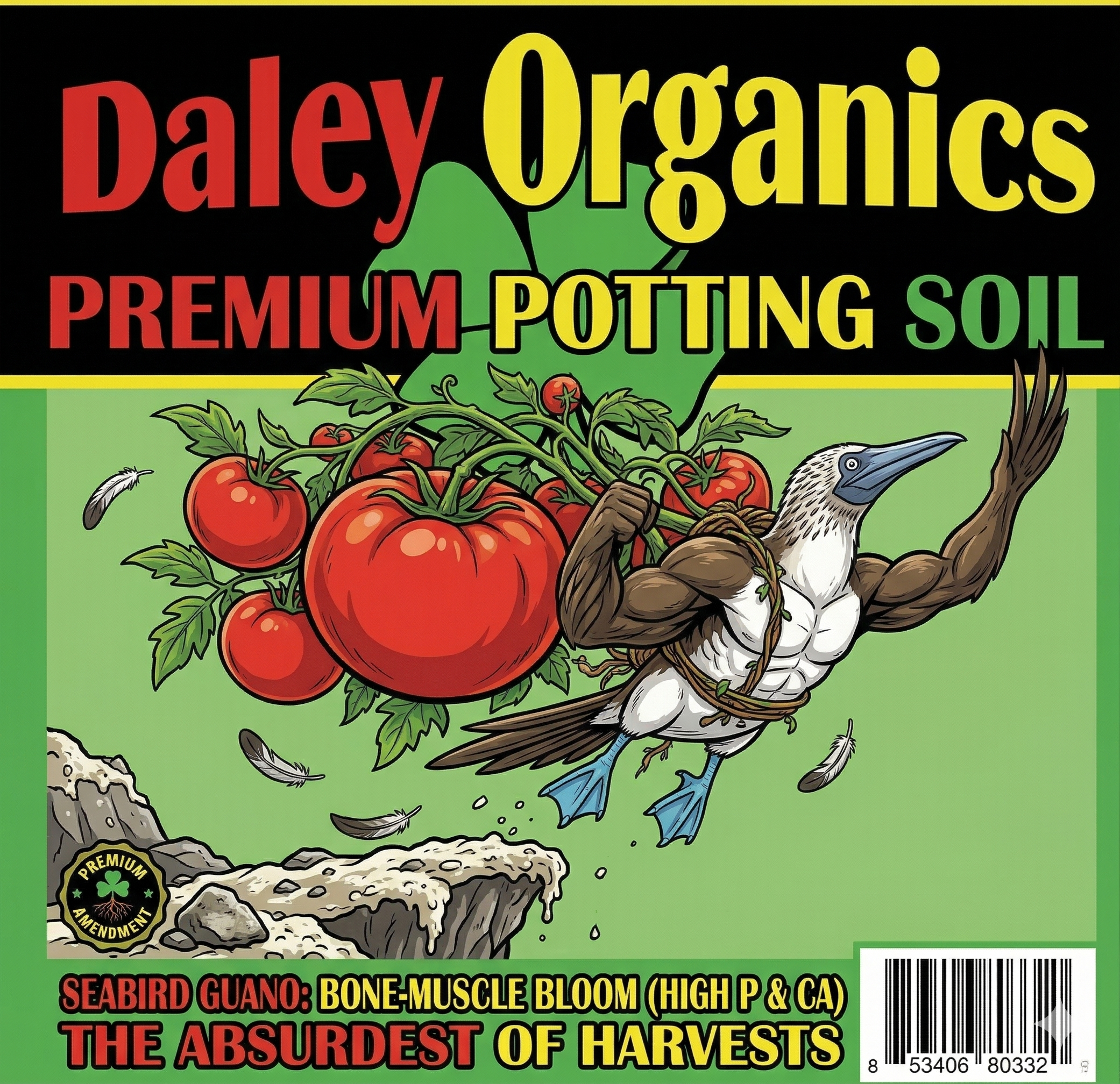
Today, seabird guano is experiencing a quiet resurgence among organic growers. The reasons are the same — the stuff simply works — but the context has changed.
Balanced NPK with micronutrients. Guano provides nitrogen, phosphorus, and potassium alongside calcium, magnesium, sulfur, and trace minerals that synthetic formulations often omit.
Biological activity. Like worm castings, guano contains beneficial microorganisms. The humic acids in aged guano improve soil structure and nutrient availability.
Slow release. Mineralized guano releases nutrients gradually, reducing burn risk and providing sustained feeding.
Sustainability. Peru has re-established regulated harvesting. Strict protections for nesting seabirds are now enforced — the Inca approach, vindicated by three centuries of hindsight.
Safety note: Guano can carry histoplasmosis spores. Wear a dust mask when handling dry guano.
The guano story is about what happens when humans discover a finite resource and treat it as infinite. The Chincha Islands held thousands of years of biological wealth. It took forty years to empty them.
But the birds are still there. The cormorants still nest in their millions. The guano still accumulates — slowly, at the pace biology allows rather than the pace economics demands.
Somewhere on a rocky island off Peru, a guanay cormorant is doing what its ancestors have done for millennia: fishing the cold Humboldt Current, returning to its colony, and contributing to a deposit that humans once valued above gold.
The cormorant has no idea. It’s just doing what cormorants do.
Sources: Wikipedia — Guano · Wikipedia — Guano Islands Act · Wikipedia — War of the Pacific · Smithsonian Magazine · USDA
Want the full science behind every ingredient?
Our ingredient library covers all 26 amendments with full descriptions and product cross-references.