Soil Science
The same mineral that built the pyramids also builds perfect soil structure. The ancients knew more than they realized.
The Great Pyramid of Giza used gypsum mortar between its limestone blocks — roughly 500,000 tons of it. The Egyptians had discovered that heating gypsum drove off its water content, creating a powder (plaster of Paris) that could be mixed with water and hardened into a durable binding agent. The technique was sophisticated enough to produce mortar joints that have survived 4,500 years of desert conditions.
Gypsum’s agricultural story begins much later, but with equally impressive results.
The most famous early demonstration belongs to Benjamin Franklin. In the 1770s, Franklin spread gypsum (then called “land plaster”) on a field near a public road and wrote in the gypsum-treated area the words “This land has been plastered.” As the season progressed, the treated area grew visibly greener and taller than the surrounding untreated field. Passersby could literally read Franklin’s message in the contrast between fertilized and unfertilized growth.
It was arguably history’s first large-scale fertilizer demonstration plot.
Gypsum’s most remarkable agricultural property has nothing to do with plant nutrition. It’s structural.
Clay soils compact because clay particles carry negative electrical charges. In soils with high sodium content, sodium ions (Na⁺) — which are single-charged and weakly held — sit between clay particles. Their weak charge allows clay platelets to disperse and pack tightly together, creating dense, waterlogged, nearly impenetrable soil.
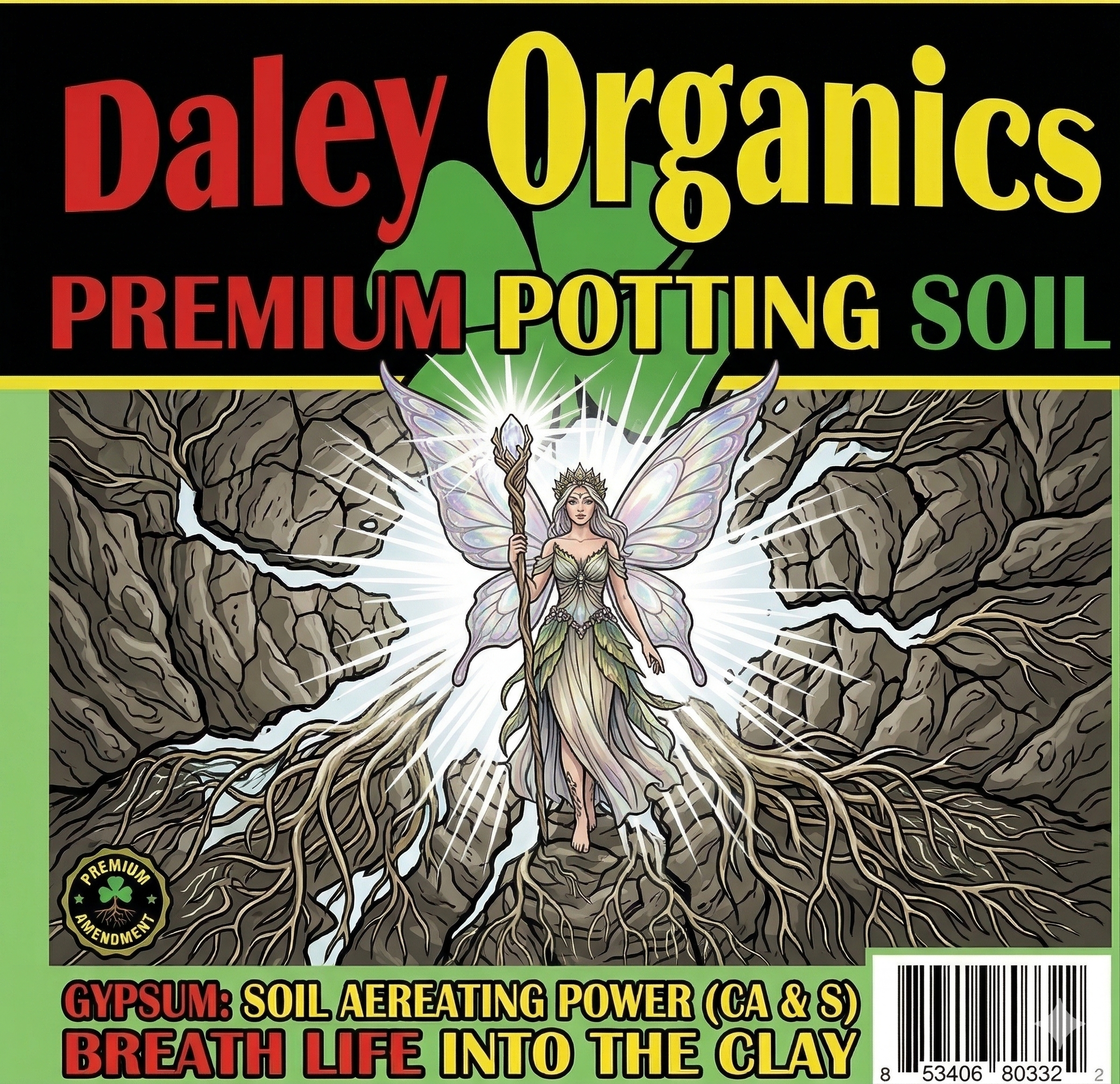
Gypsum introduces calcium ions (Ca²⁺) into this system. Calcium is double-charged and fits more tightly into the spaces between clay platelets. When calcium replaces sodium on the clay exchange sites, the particles flocculate — they aggregate into larger clumps with air and water spaces between them.
The result: compacted clay loosens. Water infiltration improves. Root penetration becomes possible. Oxygen reaches the root zone. The soil transforms from a brick into a growing medium.
This process — calcium displacing sodium — is why gypsum is the primary amendment for remediating sodic soils. In the arid and semi-arid regions of the American West, where sodium accumulates naturally and irrigation water often adds more, gypsum application is standard agricultural practice.
Critically, gypsum accomplishes this without changing soil pH. Agricultural lime also provides calcium and improves clay structure, but it raises pH — sometimes dramatically. In soils that are already alkaline (common in arid regions), adding lime makes the problem worse. Gypsum provides the calcium without the pH shift.
Calcium and sulfur are both essential plant nutrients that rarely appear on fertilizer labels or in gardener conversations. They’re the quiet deficiencies — widespread enough to limit yield and quality, underrecognized enough to go uncorrected.
Calcium deficiency causes blossom end rot in tomatoes and peppers, tip burn in lettuce, bitter pit in apples, and internal browning in potatoes.
Sulfur deficiency causes uniform yellowing of new leaves (unlike nitrogen deficiency, which yellows old leaves first), reduced protein content in crops, and poor flavor development in alliums like garlic and onions.
Gypsum provides both. Its calcium is immediately plant-available — it dissolves readily in soil water, unlike the calcium in limestone which requires acid dissolution. Its sulfur is in sulfate form (SO₄²⁻), directly usable by plants without microbial conversion.
Gypsum comes from two main sources, and the distinction matters for organic growers.
Natural gypsum is mined from geological deposits formed by the evaporation of ancient seas. Major deposits exist across the US, with significant mining operations in Iowa, Oklahoma, Texas, and Nevada. Natural gypsum is OMRI-listed for organic production.
FGD gypsum (flue gas desulfurization gypsum) is a recycled byproduct of coal-fired power plants. It’s chemically identical to natural gypsum, but concerns about trace contaminants (mercury, other heavy metals) from the coal combustion process have kept FGD gypsum off most organic-approved lists.
For garden use, natural mined gypsum is the safe choice.
Important distinction: Gypsum improves clay soil compacted due to sodium. It does NOT improve clay soil compacted by physical pressure (foot traffic, machinery). If your clay problem is mechanical compaction, you need physical amendments — organic matter, pumice, perlite — rather than gypsum.
Benjamin Franklin was, among his many accomplishments, one of America’s first soil scientists. His gypsum demonstration wasn’t just showmanship — it was empirical agricultural research conducted in public view, designed to persuade skeptical farmers that mineral amendments could transform their yields.
Two hundred and fifty years later, the mineral he spread on that Pennsylvania field is still solving the same problems: tight soil, calcium deficiency, sulfur depletion. The science has advanced. The application rates have been refined. The understanding of clay chemistry and cation exchange would have fascinated Franklin.
But the basic observation — spread this white powder on soil and things grow better — remains as true today as it was when passersby read his message growing in a Pennsylvania field.
Sources: Wikipedia — Gypsum · Wikipedia — Sodic soil · USDA NRCS — Gypsum · Ohio State University Extension
Want the full science behind every ingredient?
Our ingredient library covers all 26 amendments with full descriptions and product cross-references.
Keep Reading