Soil Science
There’s an internet under your feet, and it’s been running for 400 million years.
The discovery didn’t happen in a Silicon Valley lab. It happened in the dirt, through microscopes, over decades of painstaking observation by mycologists and soil ecologists who gradually realized that the roots they were studying weren’t operating alone.
Nearly every plant in your garden — your tomatoes, your roses, your oak tree, your lawn grass — is plugged into a fungal network so vast and so old that it predates the evolution of seeds themselves. The partnership between plants and mycorrhizal fungi began roughly 400 million years ago, when the first plants colonized land. The fossil record from the Rhynie chert in Scotland — some of the oldest preserved plant tissue on Earth — shows fungal structures inside plant cells that are virtually identical to modern mycorrhizae.
Plants didn’t conquer land alone. They did it with fungal partners. And they’ve never stopped relying on them.
The mycorrhizal partnership is a trade agreement, negotiated at the molecular level and honored for four hundred million years.
The plant produces sugars through photosynthesis. The fungus can’t photosynthesize — it needs carbon from another source. So the plant feeds the fungus: up to 20% of its photosynthetic output can flow to its mycorrhizal partner.
In return, the fungus does something the plant can’t do for itself: it explores soil.
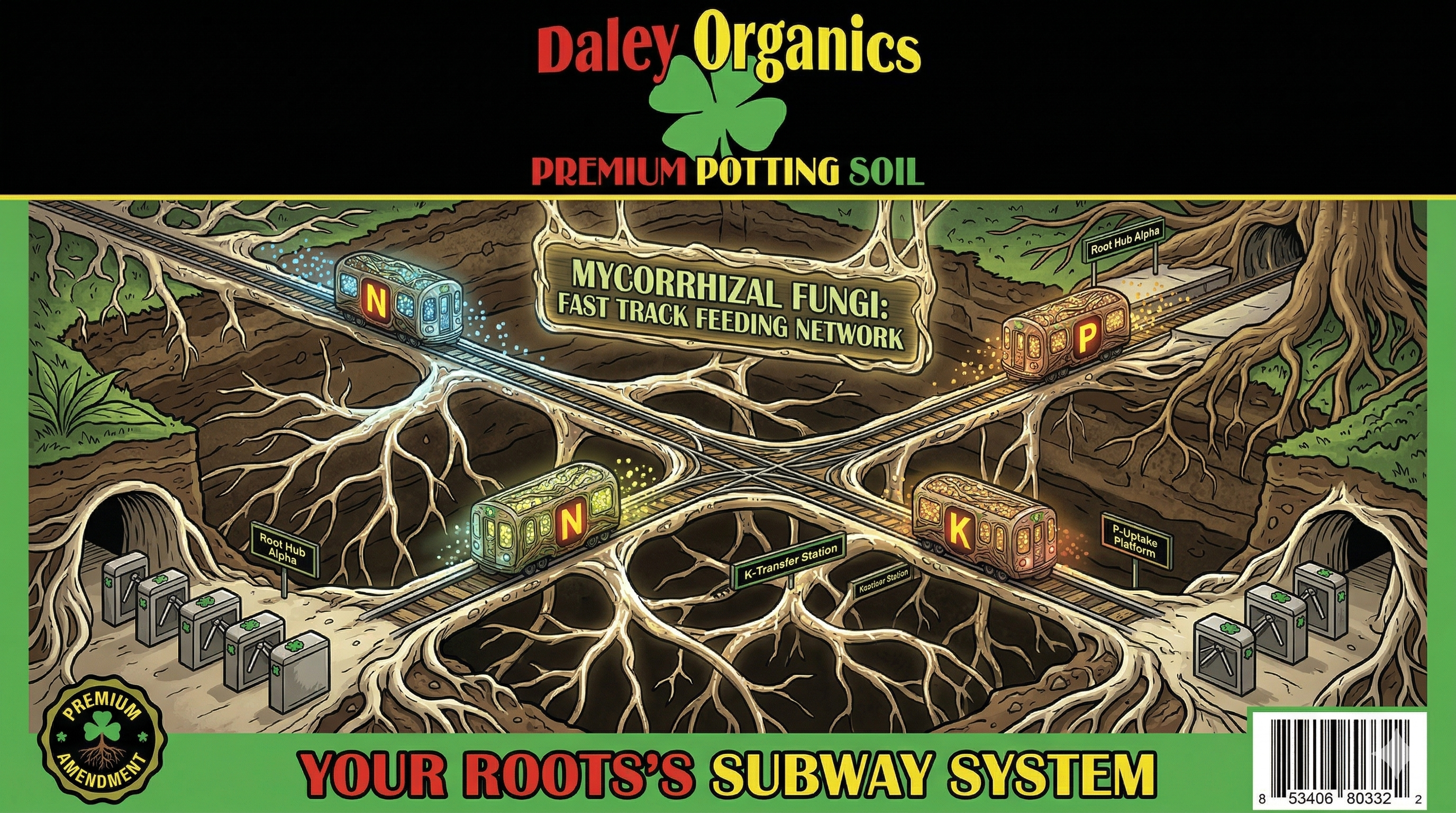
Plant roots are thick, relatively slow-growing structures. They’re effective at anchoring and absorbing nutrients from the immediate root zone, but they can’t reach far. Fungal hyphae — the hair-thin filaments that make up the body of the fungus — are microscopically thin and grow rapidly. A single plant with a mycorrhizal partnership can access soil volume 700 times greater than its roots could reach alone.
The hyphae mine phosphorus, zinc, copper, and water from distances and soil pore sizes that root hairs physically cannot penetrate. These resources are transported back through the hyphal network to the plant root, where they’re exchanged for sugar at specialized structures called arbuscules.
Phosphorus delivery is the headline benefit. In low-phosphorus soils — which includes most natural soils — mycorrhizal plants can access 2–5 times more phosphorus than non-mycorrhizal plants. This single advantage can mean the difference between a plant that thrives and one that struggles.
The mycorrhizal network doesn’t just connect a single plant to its fungal partner. It connects multiple plants to each other through shared fungal networks.
This “Wood Wide Web” — a term coined by forest ecologist Suzanne Simard — allows resource sharing between connected plants. Carbon, nutrients, water, and even chemical defense signals can flow through the network from one plant to another.
Simard’s research in British Columbia’s forests documented that large “mother trees” fed carbon through mycorrhizal networks to shaded seedlings, essentially subsidizing the next generation. Trees under insect attack sent chemical warning signals through the network, triggering defensive chemistry in connected neighbors before the insects arrived.
In a garden context, the implications are significant. A diverse, mycorrhizae-rich garden isn’t a collection of isolated plants. It’s a connected community sharing resources and information underground. The mature tomato plant with deep mycorrhizal connections may be subsidizing the newly transplanted pepper next to it.
Here’s the uncomfortable part: standard gardening practices systematically destroy mycorrhizal networks.
Tilling. Mycorrhizal hyphae are physically fragile. Running a tiller through soil shreds the hyphal network. The fungi must rebuild from surviving root fragments and spores — a process that takes weeks to months. Annual deep tilling means the network never fully establishes.
Synthetic phosphorus fertilizer. When plants receive abundant phosphorus through synthetic fertilization, they reduce their investment in mycorrhizal partnerships. Why trade 20% of your sugars for phosphorus delivery when phosphorus is already flooding the root zone? The fungi are effectively fired. Over years of heavy synthetic phosphorus use, mycorrhizal populations in soil decline dramatically.
Fungicides. Many broad-spectrum fungicides don’t distinguish between pathogenic and beneficial fungi. Mycorrhizae are collateral damage.
Bare soil. Mycorrhizal fungi need living plant roots to survive. Periods of bare fallow — common in conventional agriculture — starve the network. Cover cropping maintains the living root system that feeds mycorrhizae year-round.
The solution isn’t to stop gardening. It’s to garden with the network rather than against it.
Important: Some plant families do NOT form mycorrhizal partnerships — Brassicaceae (cabbage, broccoli, kale, radish), beets, spinach, and chard gain no benefit from inoculants.
Mycorrhizal fungi are not optional. They’re not a garden supplement or a trendy biostimulant. They are a fundamental component of how terrestrial ecosystems function — as essential to plant life as sunlight and water.
Every soil mix we build at Daley Organics is designed to support and preserve this network. We use slow-release organic phosphorus sources rather than synthetics precisely because we want your plants maintaining their fungal partnerships. The microbe-first approach isn’t marketing language — it’s an acknowledgment that the fungi and bacteria in the soil are doing work we can’t replicate in a bag.
When you transplant a seedling into Daley’s Mix, you’re giving it a head start: biologically active growing media, slow-release nutrition that preserves the incentive for fungal partnerships, and organic matter that feeds the hyphae as they colonize the root zone.
The network is running. All you have to do is stop breaking it.
Sources: Wikipedia — Mycorrhiza · Wikipedia — Mycorrhizal network · Wikipedia — Suzanne Simard · New Phytologist Foundation · USDA ARS — Mycorrhizal Research
Want the full science behind every ingredient?
Our ingredient library covers all 26 amendments with full descriptions and product cross-references.
Keep Reading